Haunting Duality in in Dominique Fung’s Artwork
By Betsy Kwong | December 15, 2025
Presented by contemporary art gallery Massimo de Carlo during Hong Kong Art Week in March 2025, Dominique Fung’s inaugural solo exhibition “Beneath the Golden Canopy” featured a range of creative expressions. From an oil on canvas diptych titled Yellow Silk Screen (2025), which measured at 320 centimeters wide, to mixed media pieces, such as Found Tang Horse Heads (2024-5), which comprised of a small-scale oil on canvas painting embedded in an antique jewelry box that the artist had sourced from auctions, Fung’s body of work is not only a historical reference to the lavish lifestyle of Cixi, the Empress Dowager of China during the Qing dynasty, but also a pioneer of Asian Neo-Surrealist forms and motifs in the contemporary art scene.
Dominique Fung (b. 1987) is a second-generation Chinese-Canadian artist, who currently lives in Brooklyn, New York. In her interview with Harriet Llyod-Smith in Plaster Magazine published on 14 January 2025, Fung revealed that though she has roots in Hong Kong and Shanghai, she had felt she may have been “othering” her “own culture.” This sense of diaspora inspired her creation of artwork that had often featured “fantastical dreamscapes filled with eerie transformations and fleshy, feminine contortions.” While the artist had rejected the connotations associated with the canons of Surrealism and the uncanny in her interview with Prestige Magazine on 20 March 2025, I believe there is credit in revisiting these traditions and vernaculars to foreground and redefine power, femininity, and aesthetics in the modern-day era through a transcultural and transdisciplinary perspective.
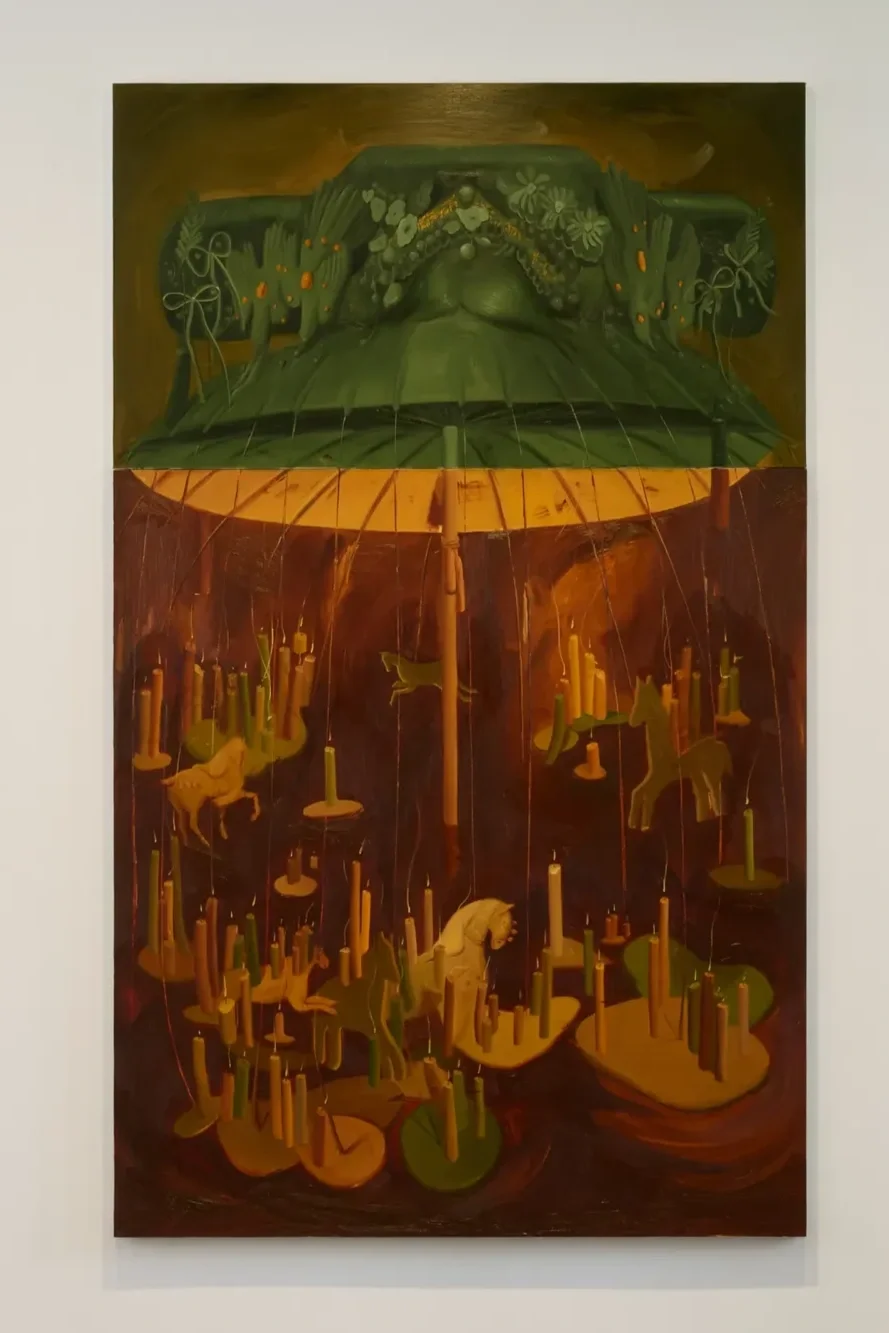
Duality of Villain and Victim (2025). Oil on canvas. Massimo de Carlo.
To reflect on her transcultural experience, Fung’s haunting creative expressions and the use of dramatic lighting in her work connect cinematic composition with modern-day imagination. In Duality of Villain and Victim, which is one of the only horizontal paintings in this exhibition, I am reminded of the cult classic horror films in Hong Kong in the 1980s. In these films, stiff-limbed zombies are dressed in Qing Official robes while they don a court hat with a feather and hop around town to scare and attack humans. The umbrella-shaped headdress tinged with an eerie moss-green tone holds the dangling of horses, candles, and broken limps in some sort of nightmarish merry-go-around arrangement. The lower half of the painting is spotlighted by what the artist calls an “interior glow.” Fung uses a layering and juxtaposition of western and eastern motifs and objects to play with the notion of ornamentalism, which is “a conceptual framework” introduced by cultural theorist Anne Anlin Cheng, used “for approaching a history of racialized person-making, not through biology but through synthetic inventions and ornamentations.” The duality in this composition is an enmeshment of innocence, horror, and disillusionment, which foregrounds the sentiments of a transcultural lived experience with surreal representations.
While a lot of diasporic artwork is centered around the impact of World War II and is produced prior to the Immigration Act of 1965 in the United States, the contemporary Asian art scene has since extended this legacy by claiming spaces in other discourses, such as gender inequality and Asian diaspora. Dominique Fung’s artwork challenges the assumption that Mark Dean Johnson talks about in the anthology Asian American Art: A History, 1850-1970 (2008): “the racially essentialized notion of a fixed, foreign, and even backward Asian tradition and personality.” Fung ridicules the European and patriarchal ornamental gaze of Asian femininity with her play with objects in Neo-Surrealist paintings.
My infatuation with Dominique Fung’s haunting works extends far earlier than her recent solo exhibition in Hong Kong, tracing back to my encounter with her piece Sans Les Mains (2022) at the Huntington Library in summer 2024. The title, which means “without hands” in French, captures Fung’s transcultural critique and otherworldly creative expression. Drawing from her Canadian and Chinese heritage, Fung has cultivated a distinctive Asian Neo-Surrealist aesthetics that haunts, provokes, dazzles, and demands attention from her viewers. As she has stated in her interview with Plaster, “[m]y viewpoint is feminist, as an Asian woman operating in this world.” From her first group exhibition in Toronto in 2011 to her upcoming appearance at Frieze Seoul in September 2025, Fung’s artistic evolution has been remarkable to witness. I await with pleasure to see what strange and beautiful monstrosities she will conjure next.