the art of memory in elah wong tsoi wai’s paintings
By Betsy Kwong | September 20, 2025
In the summer of 2025, Hong Kong-based artist Elah Wong Tsoi Wai showcased 18 pieces of her work at Gallery EXIT. This is her first solo exhibition since she graduated with a Bachelor of Arts (Hons) in Visual Arts from Hong Kong Baptist University. While a majority of her work from this recent collection explores the dynamic movements of the body and the orientation of subspaces within her canvases, I am drawn to her paintings that consist of a static, frozen-in-time composition that looks as though the artist has simply left it unfinished. These works evoke an impressionist style of fragmentation, undermined by the quiet nostalgia of faded memories.
“Memories,” as Kazuo Ishiguro writes in his novel Never Let Me Go, “fade surprisingly quickly. But…the memories I value most, I don’t ever see them fading.” This idea of memory being a subjective and emotional condition speaks to the biases and affinities encoded in the human mind. Instead of defining memory as merely the pragmatic utility of the brain to store information (as is common in the sciences), Wong’s works invite us to consider memory as a form of art. Her 2024 painting To (xxx), for instance, depicts an elderly couple turned away from its spectator. They appear to be nameless, faceless, and directionless, which correspond to the exhibition’s theme of “unknown.” The patchwork of brushstrokes and the layering of textures and techniques from silk and acrylic paint in the work illustrate an impression of everyday life that deviates from traditional representations that are focused on realism. By harnessing a sense of selective forgetfulness, this reimagination of memory as art plays with reality and fiction and attests to why certain creative works have survived the test of time, despite our unreliable and faded memories.
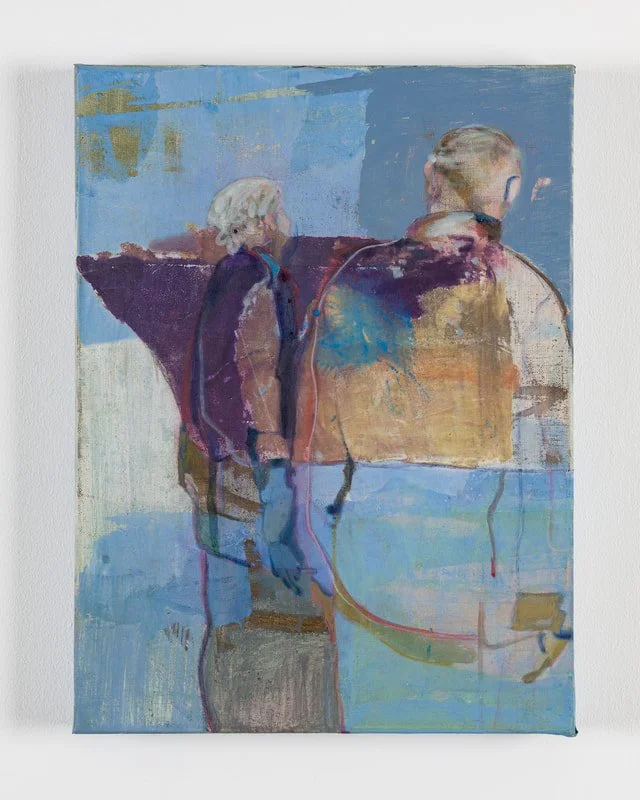
To (xxx). Silk and acrylic on canvas. 2024.
The seemingly incomplete composition in To (xxx) is the artist’s deliberate stylistic choice to foreground a sentiment that memories may fade but the emotions attached to it will not. This atmospheric depiction of the human psyche reminds me of another Ishiguro novel called The Buried Giant, which is a literary magical realist tale about an elderly couple’s journey through the vast empty lands of England during the Dark Ages and the mysterious mist that covers the whole country and causes mass cases of amnesia. In forgetting personal history, we risk losing collective memory. Wong’s painting illustrates an understanding of memory as a human and cultural experience governed and maintained by our emotional attachments. The layering of paint and textures foregrounds a material dimension in the art of memory. This technique juxtaposes and overlaps the known and unknown in the subspaces of a canvas to make room for diverse imagination and observation. As the title suggests, To (xxx) is the artist’s homage to the impressionists’ ideologies—refusing to name something to avoid making it “known” and rejecting established styles to express modern life authentically.
In an article published by the Metropolitan Museum of Art titled “Impressionism: Art and Modernity,” Margaret Samu contends that the impressionist technique, which is pioneered by a group of French artists in the late nineteenth century, challenges traditional academic painting by using a “seemingly casual style” to produce a “new language with which to depict modern life.” In Moon River (2025), which is one of Wong’s latest works, she builds on the impressionist art movement by stripping away the details of the composition to draw attention to two focal points: a person on a boat and dot(s) that symbolize(s) the moon. The mystic ambience created with simplified forms by the artist resembles Claude Monet’s Impression, Sunrise (1874). However, instead of capturing fleeting moments in real-life like Monet, Wong’s near-abstract painting offers an ambiguity in the composition. While the conspicuous blue dot close to the center of the painting seems like a purposeful placement of the moon, the more obscure white dot at the top left corner of the canvas questions the tension between reality and memory. Which dot is the ‘real’ moon? This ambiguity sparks a playful conversation between a young, emerging artist from Hong Kong and the old masters from France, which embodies the principles of the art of memory and its cultivation.
Echoing the faceless subjects in To (xxx), Wong contemporizes the contemplation of the quotidian, which is characteristic of impressionism, by painting a textured and weathered background in Moon River to compel more attention to its subjects. The swath of rustic pink acrylic paint on the canvas brings the subjects of the work to the foreground, which adds to the conception of faded memories with an undertone of yearning. In Contemporary Art and Memory: Images of Recollection and Remembrance, Joan Gibbons argues that memory is “both a form of knowledge and an agent of imagination.” The romanticization of memory in Wong’s painting contradicts and intersects aesthetically and viscerally to illustrate the constitution of the art of memory as partially constructed.
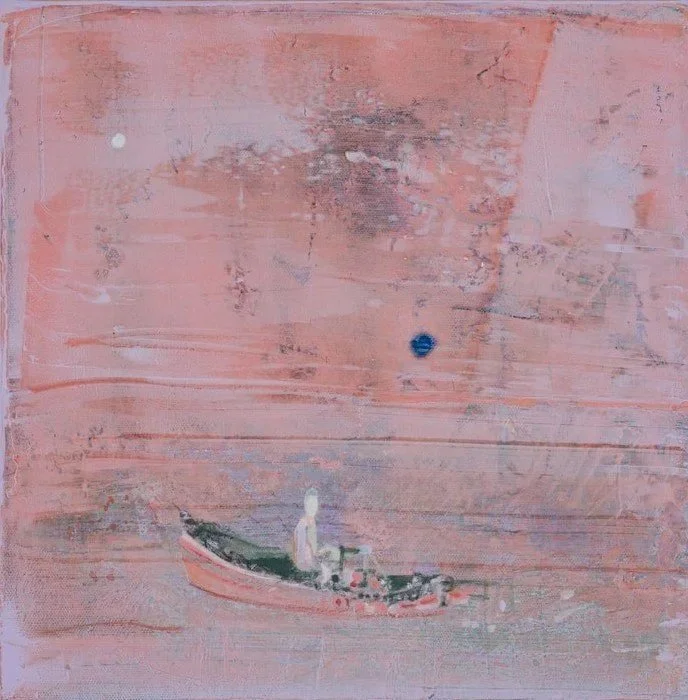
Moon River. Acrylic on canvas. 2025.
While the traces of impressionist ideology are evident in Wong’s work, the two paintings I have discussed here show that the artist has taken creative liberty to redefine impressionism with the use of bold colors and more abstract forms. This conversation between a generation z artist trained in a local institute (presumably with knowledge of classic techniques, styles, and their history) and the impressionists who originated from a time when they were considered radical and the avant-garde, Elah Wong Tsoi Wai’s works have local and universal appeal (both works have already sold). In portraying the “absurdity of the modern world,” as noted in her artist statement, Wong’s paintings suggest that memories fade to make room for new ones to intermingle and take root. Contemporary art reflects cultural and societal norms and fears of the present, but it is also an intertextual and historical genre. Playing with juxtapositions and tensions between the old and new is at the core of the art of memory.